
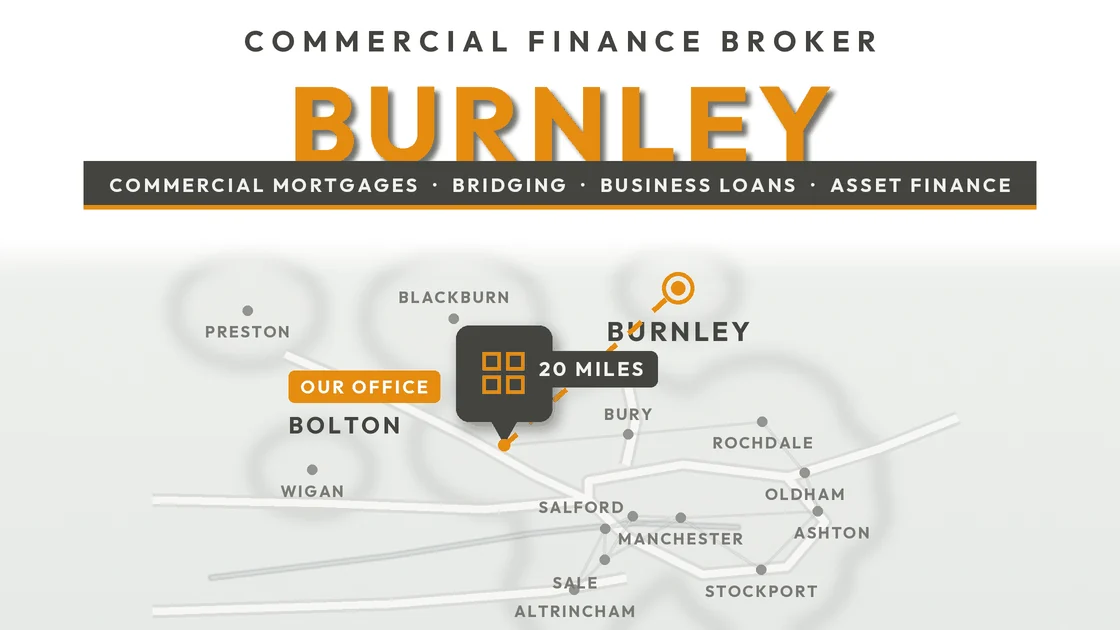
Bolton Business Finance is an independent commercial finance broker working with businesses and property investors across Burnley and Pennine Lancashire. We arrange business funding, commercial mortgages, bridging, development finance, asset finance, invoice finance and merchant cash advances. Our office is twenty miles away, about forty minutes along the M65.
We are the commercial finance broker Burnley businesses can actually sit down with. We do not lend ourselves. We approach the lenders most likely to say yes to your particular case, and we will come to your premises rather than handle the whole thing by email.
Written by Marcus Wright, owner and founder of Bolton Business Finance Ltd, in financial services since 2008 and a commercial finance broker since 2019. Last reviewed September 2026.
On this page
- We will come to you in Burnley
- Corporate finance in Burnley
- Aerospace, engineering and the supply chain squeeze
- Commercial mortgage broker Burnley
- Asset finance and invoice finance
- Bridging finance in Burnley
- Buy to let and property investment
- Development finance in Burnley
- What we do not do
- Burnley businesses we work with
- Meeting us in Burnley
- Burnley commercial finance FAQs
- Apply for commercial finance in Burnley
The short version
- A commercial finance broker arranges funding for businesses from lenders across the market, rather than lending money itself.
- Corporate finance for a smaller business usually means debt: a term loan, an acquisition facility, a refinance of existing borrowing, or funding secured on assets or invoices.
- UK lenders typically advance up to 70% of value on commercial property and up to 75% on semi-commercial, over terms of 3 to 25 years.
- More than 100 lenders are active in the UK commercial funding market. A decline from one tells you about that lender’s criteria rather than about your business.
- A commercial mortgage in Burnley usually takes 3 to 6 months from enquiry to completion. Business loans, asset finance and invoice finance can complete in days.
We Will Come To You In Burnley
Burnley is about twenty miles from Westgate House. The usual run is north on the A666 through Darwen and Blackburn, then east along the M65, which puts us in Burnley town centre in roughly forty minutes. Padiham and Hapton come up a few minutes earlier off junction 8 or 9, and Worsthorne and Cliviger are a little past the town on the far side.
That matters in Burnley because a great deal of what needs funding here is physical. A machine shop with half a million pounds of equipment on the floor, a unit on an industrial estate with a yard and a crane, a mill building part let and part empty. None of that comes across properly in an application form, and lenders make very different decisions once someone has actually walked the site.
| Item | Detail |
|---|---|
| Areas covered | Burnley town centre, Padiham, Hapton, Worsthorne, Cliviger, Rosegrove, Burnley Wood and Whittlefield, plus Nelson, Brierfield, Colne and Clitheroe across Pendle and the Ribble Valley |
| Distance from our office | About twenty miles via the A666 and M65. Forty minutes off peak, longer at rush hour through Blackburn |
| Products arranged | Business and corporate loans, commercial mortgages, bridging, development finance, asset finance, invoice finance, merchant cash advances |
| Lender panel | Over 135 lenders, from high street banks to specialist and non-bank funders |
| Broker fee | None on most facilities, we are paid a disclosed commission by the lender. Property secured deals carry £495 upfront and 1% on completion |
| First meeting | Free, at your premises, your accountant’s office or ours |
| Regulatory status | Not FCA authorised. Non-regulated business finance only. No residential mortgages |
Corporate Finance in Burnley

Corporate finance means two quite different things depending on who you ask, and it is worth being clear which one you need before you start ringing people.
An accountancy firm’s corporate finance team advises on selling a business, buying one, valuations and due diligence. That is advisory work and it is not what we do. What we do is the funding side: arranging the debt that sits underneath those transactions, and the facilities a growing business needs day to day. For most owner managed businesses in Burnley, that second definition is the one that actually matters.
What we arrange under that heading
- Growth and working capital funding. Term loans from £10,000 to £500,000 unsecured, considerably more against security.
- Acquisition finance. Funding to buy a competitor, a book of business or the trade and assets of another company.
- Funding for management buyouts and partner exits. We arrange the borrowing that sits behind the deal. We do not advise on or arrange the share transaction itself, and you will need a corporate finance adviser or a solicitor for that part.
- Refinancing existing debt. Consolidating facilities, replacing expensive borrowing, or releasing equity from assets already owned.
- Asset based lending. Facilities secured on plant, machinery, stock or the debtor book rather than on property.
The common thread is that none of these are products you walk into a branch and ask for. They are structured around the specific business, and the lender that funds a £250,000 acquisition well is rarely the same one that funds a £40,000 equipment purchase well. That is the whole argument for going through a broker rather than to one bank.
Aerospace, Engineering and the Supply Chain Squeeze
Burnley is not a typical Lancashire mill town economy any more, and treating it like one is how funding conversations go wrong here. The borough has one of the denser concentrations of aerospace and advanced manufacturing employment in the North West, built around nacelle and composite manufacture and a long tail of precision engineering subcontractors feeding it. Burnley Bridge at Hapton, straight off the M65, added a large block of modern industrial and logistics space to a town that previously had very little of it.
Businesses in that supply chain share a specific financial shape, and it is one that mainstream lending policy handles badly.
- Long payment terms from large customers. Supplying a prime contractor or a tier one manufacturer often means invoicing on 60 or 90 day terms while paying your own suppliers and wages on far shorter ones. The order book looks healthy and the bank balance does not. This is the single most common reason engineering firms here run short of cash while growing.
- Capital equipment that costs more than the premises. A five axis machining centre, inspection equipment or an autoclave can run well into six figures. Funding that out of trading profit holds the business back for years, and a standard business loan is usually the wrong instrument for it.
- Certification and tooling costs that come before the revenue. Winning aerospace work frequently means paying for approvals, tooling and first article inspection long before the first invoice is raised. Lenders assessing you on last year’s filed accounts cannot see the contract that justifies the spend.
- Customer concentration. Depending on two or three large customers is normal in this sector and reads as risk to a credit team. It needs explaining properly rather than hoping it is not noticed.
Where these cases usually land
Rarely with a single term loan. The sensible structure is usually a combination: asset finance against the machinery, so the equipment pays for itself over its working life, and invoice finance against the debtor book, so the long payment terms stop being your problem. Splitting the requirement across two facilities of the right type will almost always beat trying to force the whole thing through one. It is also considerably cheaper, because each part is secured on something the lender understands.
The other half of Burnley’s stock is the older one. The Weavers’ Triangle and the canalside mills are the visible part, and like Oldham there is a lot of Victorian industrial building still in commercial use, subdivided and let to small firms. Those buildings raise their own funding questions, chiefly around EPC ratings, tenant covenant and how far two valuers can land apart on the same property.
Commercial Mortgage Broker Burnley

A commercial mortgage is a loan secured against property used for business purposes. That covers premises your own business trades from, and property you buy to let to a commercial tenant. Terms usually run 3 to 25 years, occasionally up to 30. Lenders typically advance up to 70% of value on commercial property and up to 75% on semi-commercial, meaning a shop or office with a flat above it.
Burnley has a particular advantage and a particular problem here, and they are the same thing. Commercial property is cheap. A unit that would cost three times as much in Trafford or Cheshire is within reach of a business that has never owned its premises before. The problem is that when the purchase price is low, the lender’s minimum loan size starts to bite. Plenty of high street lenders will not write a commercial mortgage below £100,000 or so, which quietly rules out a good proportion of the Burnley market and sends owners toward specialists without anyone explaining why.
What decides your terms
- Property type. Standard industrial and offices attract the widest choice. Pubs, hotels, care homes and petrol stations attract specialists only.
- Whether you occupy it or let it. Owner occupied is assessed on your trading accounts. Investment is assessed on the rent and the strength of the tenant.
- Lease length. A short unexpired lease on an investment property narrows the field quickly.
- Trading history. Two years of filed accounts opens most doors. Less than that pushes you toward specialists.
- Loan size. Below about £100,000 the mainstream choice thins out sharply, which matters more in Burnley than in most towns.
- Condition and EPC. On older mill and canalside stock this decides more than people expect.
The distinction that catches people out is investment against trading. If you are buying premises to run your own business from, the lender underwrites your business. If you are buying to let it out, the lender underwrites the rental income and the covenant behind it. Same building, two entirely different applications, and often two entirely different lists of lenders.
Be realistic on timing. In our experience a commercial mortgage takes 3 to 6 months from first enquiry to completion, and longer on a complicated case. Valuation and legal work are the two stages that overrun most often. If your deadline is weeks rather than months, bridging is usually the honest answer and we will say so.
Our main commercial mortgage broker page sets out lender appetite and typical loan to value by property type, from industrial and offices through to pubs, care homes, petrol stations and places of worship.
Asset Finance and Invoice Finance in Burnley
Across the UK, 99.18% of businesses employ fewer than 50 people and around three quarters employ nobody beyond the owners, according to the government’s Business Population Estimates for 2025. Burnley’s business base sits firmly at that end. That matters because most high street lending policy is built around businesses considerably larger, which is why small firms with perfectly sound trading get turned away.
What we arrange most often for Burnley businesses:
- Asset finance, for machinery, vehicles and plant, with nil deposit options, balloon payments where they help cash flow, and no broker fee
- Invoice finance, releasing cash tied up in unpaid invoices, which suits engineering, haulage, contracting and anyone supplying large customers on long terms
- Unsecured business loans, typically £10,000 to £500,000, decisions in days rather than weeks
- Secured business loans, larger sums against property, slower but cheaper
- Merchant cash advances, repaid as a percentage of card takings, which suits retail and hospitality
If you have already been declined
A decline tells you about that lender’s criteria rather than about whether your business can be funded. Lenders refuse cases for reasons that have nothing to do with the strength of the business: sales below their minimum, a director who does not own a home, a payment provider their systems cannot read, an application already sitting with another introducer. We have placed cases that had been turned down repeatedly, with nothing about the business having changed. What changed was which lender was looking at it.
Bridging Finance in Burnley
Bridging is short term property lending, usually three to eighteen months, priced monthly and repaid from a sale or a refinance. In Burnley it comes up most often on property bought cheaply at auction, and on older industrial and mill stock that needs work before any term lender will look at it.
- Buying at auction, where completion is fixed at twenty eight days
- Buying a property no mainstream lender will touch, typically no kitchen, no bathroom or serious damp
- Buying a mill or industrial building that needs work before it can be let or refinanced
- Breaking a chain when a sale slips
- Raising working capital quickly against property already owned
The number that catches people out
Bridging lenders size the loan against the 180 day value, not the open market value. That is what the property would fetch in a forced six month sale, and it is routinely 10% to 20% below the figure in the valuation you paid for. On low value stock the shortfall bites harder than people expect, because the lender’s minimum loan and the fixed costs of the deal do not shrink in proportion. A bridge on a £70,000 terraced property can be proportionally far more expensive than one on a £700,000 building.
Buy To Let and Property Investment in Burnley
Burnley has spent years being recommended as a high yield location, and the current numbers complicate that story in a way worth understanding before you buy. According to ONS and HM Land Registry data, the average house price in Burnley was £135,000 in June 2026, up 9.9% on the year from £122,000. Average private rent was £628 a month in July 2026, up 2.9% from £610.
Both of those look like good news. Read them together and the picture changes. Prices rose 9.9% while rents rose 2.9%, which means the gross yield has gone backwards, from roughly 6.0% a year ago to roughly 5.6% now. Burnley is still one of the cheapest entry points in England, at well under half the North West average of £220,000 and around half the UK average of £272,000. But the yield advantage is narrowing, not widening, and it is narrowing because of capital growth rather than falling rents.
That has two practical consequences. If you bought here three or four years ago, your equity position is considerably stronger than your rental yield suggests, and a refinance may release more than you assume. If you are buying now on a yield model built from older figures, the arithmetic no longer works the way the spreadsheet says. Terraced property, which is most of the Burnley rental stock, rose fastest of all at 10.6% over the year.
Business purpose only
We arrange buy to let and property investment finance on a business basis only, through limited companies, partnerships and portfolio landlords. We are not FCA authorised and we do not arrange consumer buy to let, regulated buy to let or any residential mortgage. If the property is or will be lived in by you or a close family member, that is regulated business and you need an FCA authorised mortgage adviser instead.
Development Finance in Burnley
Development finance funds building work rather than a purchase. It is released in stages against a schedule of works, with a valuer signing off each drawdown, and it is repaid on sale or on refinance onto a term product once the scheme is finished and let.
In Burnley the most common cases are conversions rather than new build. A mill or a former commercial building turned into flats or small units, or a tired terrace block brought back into use. Those schemes are viable here largely because the entry cost is low, but they carry a specific risk that lenders watch closely: on lower value stock the finished figure is easier to overrun, because build costs are broadly the same as anywhere in the North West while the end value is not. A £40,000 cost overrun matters far more against a £300,000 gross development value than against a million pound one.
- Land or acquisition drawdown. Usually up to 60% to 70% of the purchase price, released on completion.
- Staged build drawdowns. Released in arrears against work completed and signed off by the lender’s monitoring surveyor.
- Practical completion. Final drawdown, and the point at which the exit route has to be real rather than intended.
- Exit. Sale of the units, or refinance onto a commercial mortgage or buy to let facility.
What We Do Not Do
We do not arrange residential mortgages of any kind. A significant number of people reach this site searching for a mortgage broker or mortgage adviser in Burnley for a home to live in. We cannot help with that, and it is better to say so plainly than to take the enquiry.
Bolton Business Finance Ltd is not authorised or regulated by the Financial Conduct Authority. We arrange non-regulated commercial and business finance only. That means we cannot advise on or arrange: residential mortgages, first time buyer mortgages, remortgages of your own home, consumer buy to let, equity release, or any consumer credit.
If you need any of those, use the FCA’s Financial Services Register to find an authorised adviser in your area. If you are a business owner, a landlord holding property through a company, or a property investor funding on a commercial basis, then you are in the right place and we can help.
Burnley Businesses We Work With
The Burnley economy leans harder toward manufacturing than the national average, and that shapes what gets asked for. The enquiries that come from this part of Lancashire tend to fall into a few recognisable groups.
- Precision engineering and subcontract manufacturing, on the industrial estates around Rosegrove, Hapton and Burnley Bridge. Asset finance for machinery, invoice finance for the payment terms.
- Haulage and distribution, using the M65 corridor. Vehicle and trailer finance, and invoice finance against contract work.
- Construction and trades, where the problem is nearly always the gap between doing the work and being paid for it.
- Retail and hospitality, in the town centre, on St James’s Street and around Padiham. Merchant cash advances and short term working capital.
- Property investors and landlords, buying terraced stock and small commercial units on a company basis, across Burnley, Nelson, Brierfield and Colne.
Meeting Us in Burnley
We do not have an office in Burnley and we are not going to pretend otherwise. We are based at Westgate House in Bolton and we travel. For Burnley that is a forty minute drive, and we do it regularly enough that fitting you in is rarely a problem.
Where we will meet you
- At your premises, anywhere in Burnley, Padiham, Hapton, Worsthorne or out toward Nelson and Colne. Usually the most useful option, because we can see the site and the equipment.
- At your accountant’s office, which often saves a meeting later when the figures come up.
- At ours in Bolton, if you would rather come to us. Free parking.
- On a call or video, if the case is straightforward and nobody needs to see anything.
Burnley Commercial Finance FAQs
Do you actually visit businesses in Burnley?
Yes. Burnley is about twenty miles from our Bolton office, roughly forty minutes via the A666 and the M65, and we cover the whole borough plus Padiham, Hapton and out into Pendle. We meet clients at their premises, at their accountant’s office or on site. There is no charge for a first meeting and no obligation to proceed. If you would rather come to us, we are at Westgate House, Westgate Avenue, Bolton, BL1 4RF.
Are you FCA authorised, and does that matter for a Burnley business?
Bolton Business Finance Ltd is not authorised or regulated by the Financial Conduct Authority. We arrange non-regulated commercial and business finance only, which does not require FCA authorisation. It matters in one direction: we cannot help with residential mortgages, consumer buy to let or consumer credit, and a fair number of Burnley searches are for exactly that. If your borrowing is for business purposes, through a company, a partnership or as a property investor, FCA authorisation is not required for the facilities we arrange. We are a member of the National Association of Commercial Finance Brokers.
How long does a commercial mortgage take?
Typically 3 to 6 months from first enquiry to completion, and longer on a complicated case. Valuation and legal work are the two stages that overrun most often. If your deadline is weeks rather than months, bridging is usually the honest answer and we will tell you that rather than start an application that cannot land in time.
How much can I borrow?
On commercial property, typically up to 70% of value, or up to 75% on semi-commercial. On unsecured business loans, commonly £10,000 to £500,000 depending on turnover and trading history. On asset finance it is driven by the asset itself, with nil deposit options available. On invoice finance, usually up to 90% of the invoice value released within a day or two of raising it.
Can you help if I have already been declined?
Often, yes. A decline reflects one lender’s criteria, not a verdict on your business. Lenders turn cases down for reasons that have nothing to do with whether the business is sound, and with more than 135 lenders on our panel the question is usually which one to approach rather than whether anyone will look at it. Tell us who has already seen the case, because approaching the same lender twice through a different route does not help you.
Do you charge a broker fee?
Not on most facilities. On business loans, asset finance, invoice finance and merchant cash advances we are paid a commission by the lender, which is disclosed to you. Property secured deals carry a £495 upfront fee and 1% on completion. You will know the full cost before anything is submitted.
Apply For Commercial Finance in Burnley
Tell us what you need funding for
Send us the outline and we will tell you honestly whether it is fundable, roughly what it should cost, and how long it will take. No charge for the conversation and no obligation to proceed. Call 0161 546 9128 or use the form below.
About the author
Marcus Wright is the owner and founder of Bolton Business Finance Ltd. He has worked in financial services since 2008, beginning at Santander, and has been a commercial finance broker since March 2019. He founded the firm in 2020 and is a member of the National Association of Commercial Finance Brokers.
He arranges commercial mortgages, bridging finance, development finance, business loans, asset finance, invoice finance and merchant cash advances for UK businesses, working with a panel of more than 135 lenders. He can be reached on 0161 546 9128.
Marcus is also the author of UK Commercial Finance (2026), a commercial finance book for UK business owners and property investors.
Bolton Business Finance Ltd is registered in England and Wales, company number 12495909. Registered office: Westgate House, Westgate Avenue, Bolton, BL1 4RF.
Bolton Business Finance Ltd is not authorised or regulated by the Financial Conduct Authority. We arrange non-regulated commercial and business finance only, and do not advise on or arrange residential mortgages, consumer buy to let, equity release or consumer credit. All finance is subject to status, lender criteria and credit assessment. Your property may be repossessed if you do not keep up repayments on a mortgage or any other debt secured on it.