
Now available on Amazon
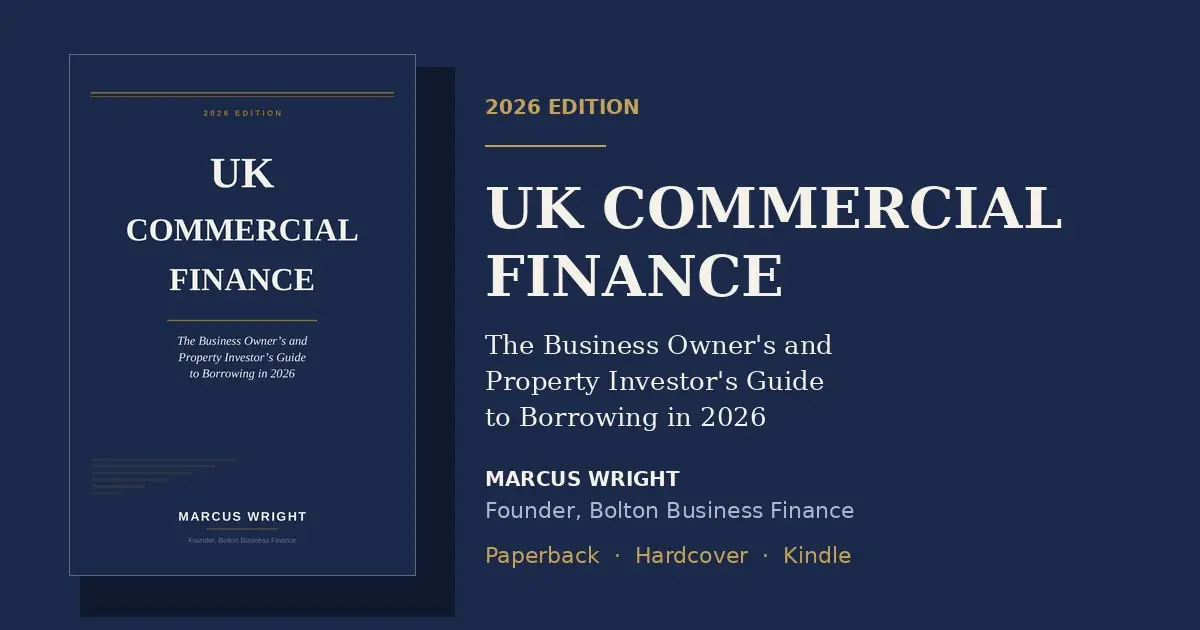
UK Commercial Finance, 2026 Edition, is out in paperback, hardcover and Kindle. Written by Marcus Wright, founder of Bolton Business Finance, and published in the United Kingdom on 24 September 2026.

Where does the money actually come from?
UK Commercial Finance is a commercial finance book for UK business owners and property investors, published in 2026. It is a business finance book and a property finance book in one volume, written by Marcus Wright, a commercial finance broker who spent more than a decade in banking. It covers what is available, what it costs, what lenders look for and where the traps are.
If you run a business or invest in property, the answers are spread across hundreds of lenders, a dozen product types and a lot of sales talk. This book puts them in one place. Where a product is the wrong answer, it says so.
Page written by Marcus Wright, author of UK Commercial Finance and founder of Bolton Business Finance Ltd. Last reviewed September 2026.
A business finance book and a property finance book in one
Most commercial finance books cover one side or the other. This one covers both, because in practice the same people need both. Part Two is the business finance book: loans, working capital, merchant cash advances, asset finance, invoice finance and government-backed lending, with what each costs and when it is the wrong tool. Part Three is the property finance book: bridging, development finance, buy-to-let, holiday lets, semi-commercial property and commercial mortgages, including the EPC rules and the Renters’ Rights Act that now shape what lenders will fund.
Parts One and Four hold them together: how the UK lending market works in 2026, how to read a term sheet, why deals stall and how to choose a broker. If you only ever buy one commercial finance book, the aim was to make it this one.
Book details at a glance
| Item | Detail |
|---|---|
| Full title | UK Commercial Finance: The Business Owner’s and Property Investor’s Guide to Borrowing in 2026 |
| Author | Marcus Wright, founder of Bolton Business Finance |
| Publisher | Bolton Business Finance Ltd |
| Published | 24 September 2026, United Kingdom |
| Edition | 2026 Edition |
| Length | 204 pages (paperback) |
| Paperback | £19.99. ISBN 978-1065433101 |
| Hardcover | £29.99. ISBN 978-1065433118 |
| Kindle | £12.99. ISBN 978-1065433125 |
| Language | English |
| Where to buy | Amazon.co.uk, all three formats |
Prices are Amazon.co.uk list prices including VAT at September 2026 and may change.
Who the book is for
It was written for business owners and property investors, and most of it speaks to them directly. A good number of the people who asked for it were not borrowers at all, though, so it has been written to work for them too.
- Business owners. Loans, working capital, invoice and asset finance, and how to tell a sensible facility from an expensive one before you sign.
- Property investors and developers. Bridging, development finance, buy-to-let, holiday lets, semi-commercial and commercial mortgages, with the numbers lenders actually use.
- Accountants and finance directors. Current cost ranges and product knowledge for the funding conversations clients bring to you, plus worked examples that show the arithmetic.
- Mortgage advisers moving into commercial. A map of the products, criteria and underwriting thinking on the commercial side.
- Anyone thinking about a career in commercial finance. The closing chapter covers the routes in, what the work involves, qualifications and how brokers are paid. If that is you, our page on becoming a self-employed commercial finance broker goes further.
- Students and lecturers. Each chapter stands alone, every product chapter ends with key takeaways and the worked examples are built to be tested.
What’s inside
The book is in four parts. Where we have a page on the same subject, the chapter name below links to it so you can go deeper on the one you need.
Part One: Introduction
The state of the UK lending market in 2026, the gap between what small businesses want to borrow and what they get, the different tiers of lender, how lenders view each sector and how lending decisions are really made.
- UK Finance Market: Trends and Key Stats
- The SME Lending Gap
- Comparing Banks and Lenders
- How Lenders See Your Sector
- How Lending Decisions Get Made
Part Two: Business Finance
Every main business finance product, what it costs and when it is the wrong choice. The part closes on the most damaging pattern in small business borrowing: stacking short-term debt.
- Personal Guarantees
- Unsecured Business Loans
- Secured Business Loans
- Working Capital Facilities
- Merchant Cash Advance
- Asset Finance
- Invoice Finance
- Offering Your Customers Buy Now Pay Later
- Stock and Trade Finance
- Business Acquisition Finance
- Government-Backed Lending
- Green and Sustainability-Linked Finance
- Loan Stacking and the Debt Spiral
Part Three: Property Investment Finance
Short-term and long-term property finance, including the Renters’ Rights Act and the EPC deadlines now shaping what lenders will and will not fund.
- Bridging Loans
- Property Development Finance
- Title Splitting
- Buy to Let Mortgages
- Holiday Lets and Serviced Accommodation
- Semi-Commercial and Mixed-Use Property
- Islamic and Sharia-Compliant Finance
- Commercial Mortgages
- Energy Efficiency, EPC and Property Finance
Part Four: Putting It Into Practice
How to raise the money, how to read an offer before you sign it, why deals stall and how to keep yours moving.
- How to Raise Business Finance
- How to Raise Property Finance
- Reading a Term Sheet
- Why Deals Stall
- Why Use a Broker, and Choosing and Working With One
- A Career in Commercial Finance
- Common Questions Answered
- Glossary of Terms, over 100 entries
- Useful Organisations and Where to Check
Four ideas from the book
- Certainty is worth paying for. A lender that says yes fast is not the same as a lender that will complete. If you have a deadline, ask who signs off credit and what has to happen before drawdown. A slightly dearer facility that completes on time usually beats a cheaper one that falls over a week before you need the money.
- Do not fix a long-term problem with short-term money. Layering one short-term facility on another to cover the last one is the most common and most damaging mistake in small business borrowing. It has its own chapter for that reason.
- A bank decline is information, not a verdict. It tells you about that bank’s credit model rather than your business. Find out the reason, because the reason decides where to go next.
- Read the default clauses before the rate. Fees, covenants and what counts as a default decide the real cost of a facility far more often than the headline percentage.
About the author

Marcus Wright is the founder and Managing Director of Bolton Business Finance Ltd, an independent commercial finance brokerage in Bolton, Greater Manchester.
He started in banking in September 2008 as a Bank Manager and then a Business Banking Relationship Manager, which gave him a close view of how lending decisions are made inside a bank. He moved into commercial finance broking in 2019 and founded Bolton Business Finance in March 2020.
The firm is a member of the National Association of Commercial Finance Brokers and works with a panel of 135+ lenders. Marcus is also a business owner and property investor himself, so he has been on both sides of a funding application. Read more about Bolton Business Finance, or connect with Marcus on LinkedIn and Amazon.
Questions about the book
What is UK Commercial Finance about?
It is a guide to borrowing for UK businesses and property investors in 2026. It explains the main business finance products, from unsecured loans and invoice finance to merchant cash advances and asset finance, and the main property finance products, from bridging and development finance to buy-to-let and commercial mortgages. For each one it covers typical costs, what lenders look for and when the product is the wrong choice.
Who wrote UK Commercial Finance?
Marcus Wright, founder of Bolton Business Finance Ltd, an independent commercial finance brokerage in Bolton. He worked in banking from 2008, including as a Business Banking Relationship Manager, moved into commercial finance broking in 2019 and founded the firm in 2020. The firm is a member of the National Association of Commercial Finance Brokers.
Where can I buy it and how much does it cost?
It is sold on Amazon.co.uk in three formats: paperback at £19.99, hardcover at £29.99 and Kindle at £12.99, all including VAT at September 2026. The paperback ISBN is 978-1065433101.
Is the book financial advice?
No. It is general information about the unregulated UK commercial and property finance markets. Figures were accurate at the time of writing in mid-2026 and are indicative ranges, not quotes. Take advice suited to your own circumstances before borrowing, particularly before signing a personal guarantee or granting a charge over property.
Will I have to give a personal guarantee?
On unsecured business borrowing, almost certainly. On secured lending it depends on how well the security covers the loan, and on some invoice finance and asset finance facilities it can be reduced or avoided. Always ask whether a capped or limited guarantee is available instead of an unlimited one.
Is a merchant cash advance a bad idea?
It is an expensive idea, which is not the same thing. For a seasonal business with strong card takings, no security and a genuine short-term need, it can be the right tool. It turns into a bad idea when it is chosen for speed rather than suitability, when nobody has worked out the true annual cost, or when it is stacked on top of other short-term facilities. You can check the cost with our factor rate calculator.
My bank said no. Does that mean nobody will lend?
No. A high street decline tells you about that bank’s lending criteria, not about your business. Challenger banks, specialist lenders and fintech funders all sit beyond the big banks. Find out why you were declined first, because the reason decides which lender to approach next.
How long does it take to raise finance?
As a rough guide: unsecured lending takes from the same day to two weeks, asset finance a few days to two weeks, and invoice finance two to four weeks to set up. Bridging takes two to eight weeks. Commercial mortgages and development finance take six to twelve weeks and sometimes longer. Legal work and valuations usually set the timetable, not the credit decision.
Is it cheaper to go direct to a lender?
Sometimes slightly, on a simple product, if you pick the right lender first time. Often it is not. Going direct means no comparison, no help with structure, a hard credit search on every application and nobody looking at your whole position. On anything secured, complex or time-critical, using a broker usually improves the odds.
Does the book cover becoming a commercial finance broker?
Yes. The chapter A Career in Commercial Finance covers the routes into the industry, what the work involves, the qualification and regulatory position and how brokers are paid. Most commercial and investment lending in the UK is unregulated, so there is no mandatory licence to arrange it, which the book treats as both the opportunity and the problem.
Read the book, or talk it through
If you would rather speak to someone about your own situation, tell us what you need and we will come back the same day with the options realistically open to you. There is no broker fee on most facilities and no obligation to proceed.
Company, product and organisation names mentioned in the book and on this page are the trade names or trade marks of their owners and are used for identification only. No named lender, trade body or firm has reviewed, approved or endorsed the book.
UK Commercial Finance is general information about the unregulated UK commercial and property finance markets. It is not personal financial, tax or legal advice and is not a recommendation of any lender, product or course of action. Figures were accurate at the time of writing in mid-2026 and are indicative only. Bolton Business Finance Ltd is an independent commercial finance brokerage, not a lender. We are not authorised or regulated by the Financial Conduct Authority and can only complete non-regulated introductions for business purposes. We may receive a commission from the lender we introduce you to, and the commission model is disclosed to clients during the process. Your property, and any other asset used as security, may be at risk if you do not keep up repayments on a debt secured against it. Registered address: Westgate House, 1 Westgate Avenue, Bolton, Greater Manchester, BL1 4RF. Company number 12495909.