
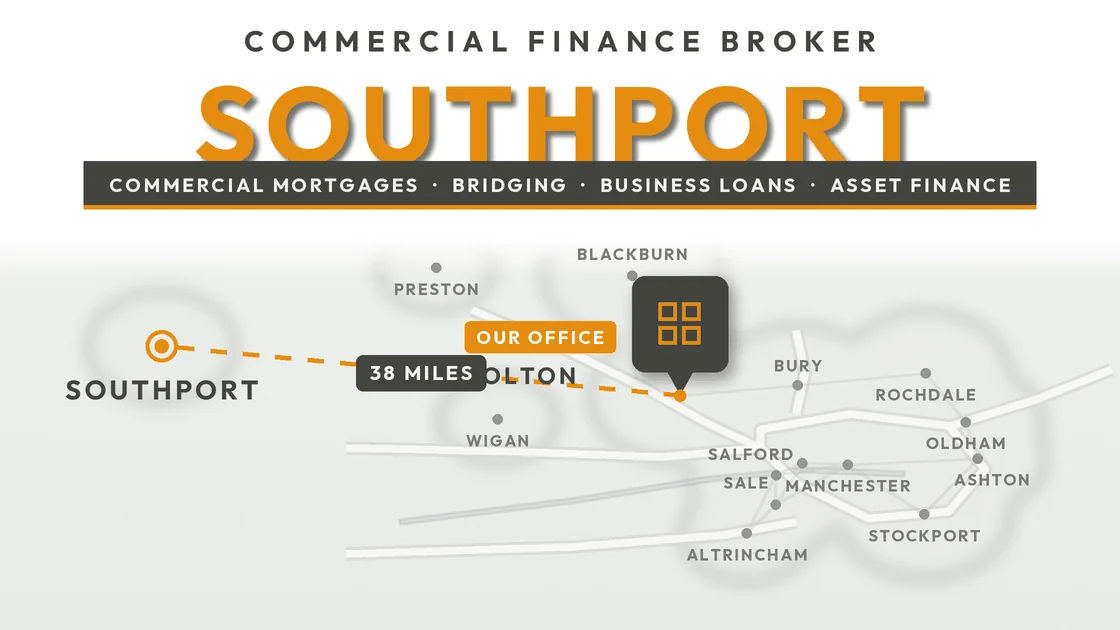
Bolton Business Finance is an independent commercial finance broker working with businesses and property investors across Southport and the Sefton coast. We arrange commercial mortgages, hotel and guest house finance, bridging, development finance, business loans, asset finance, invoice finance and merchant cash advances. Our office is thirty eight miles away, about fifty five minutes via the M61, M58 and A570.
We arrange commercial mortgages in Southport for businesses buying their own premises and for investors buying property to let. We do not lend ourselves. We approach the lenders most likely to say yes to your particular case, and on the period and listed stock that makes up much of the town centre, which lender you approach matters more than almost anywhere else we work.
Written by Marcus Wright, owner and founder of Bolton Business Finance Ltd, in financial services since 2008 and a commercial finance broker since 2019. Last reviewed September 2026.
On this page
- We will come to you in Southport
- Commercial mortgages in Southport
- Lord Street, listed buildings and conservation areas
- Hotels, golf and the visitor economy
- Bridging finance in Southport
- Business loans and asset finance
- Buy to let and property investment
- What we do not do
- Southport businesses we work with
- Meeting us in Southport
- Southport commercial finance FAQs
- Apply for commercial finance in Southport
The short version
- A commercial finance broker arranges funding for businesses from lenders across the market, rather than lending money itself.
- A commercial mortgage is a loan secured against property used for business purposes, either premises your own business trades from or a property you let to a tenant.
- Lenders typically advance up to 70% of value on commercial property and up to 75% on semi-commercial, over terms of 3 to 25 years.
- Listed and conservation area property is funded by a smaller group of lenders, because alterations need consent and energy efficiency is harder to improve.
- A commercial mortgage in Southport usually takes 3 to 6 months from enquiry to completion, and longer on a listed building.
We Will Come To You In Southport
Southport is about thirty eight miles from Westgate House, which makes it the longest run we do regularly. The route is the M61 down to the M58, then across and up the A570, and it takes around fifty five minutes when the roads are clear. Formby and Ainsdale come up before the town, and Churchtown and Marshside sit just beyond it.
We still make the journey, and on Southport property there is a specific reason for it. A great deal of the town centre stock is period, much of it is listed or in a conservation area, and a good proportion of it has upper floors that are either vacant or barely used. What condition those floors are in, whether they have separate access, and what has already been done to the building all bear directly on the valuation. None of it shows up in a set of particulars.
| Item | Detail |
|---|---|
| Areas covered | Southport town centre and Lord Street, Birkdale, Ainsdale, Churchtown, Hillside and Marshside, plus Formby and the wider Sefton coast |
| Distance from our office | About thirty eight miles via the M61, M58 and A570. Fifty five minutes off peak, longer in summer and during tournament weeks |
| Products arranged | Commercial mortgages, hotel and guest house finance, bridging, development finance, business loans, asset finance, invoice finance, merchant cash advances |
| Lender panel | Over 135 lenders, from high street banks to specialist and non-bank funders |
| Broker fee | None on most facilities, we are paid a disclosed commission by the lender. Property secured deals carry £495 upfront and 1% on completion |
| First meeting | Free, at your premises, your accountant’s office or ours |
| Regulatory status | Not FCA authorised. Non-regulated business finance only. No residential mortgages |
Commercial Mortgages in Southport

A commercial mortgage is a loan secured against property used for business purposes. That covers premises your own business trades from, and property you buy to let to a commercial tenant. Terms usually run 3 to 25 years, occasionally up to 30. Lenders typically advance up to 70% of value on commercial property and up to 75% on semi-commercial, meaning a shop or office with a flat above it.
Southport’s commercial property divides into three markets that behave quite differently. There is the town centre, dominated by Lord Street and the streets around it, which is period, largely retail and leisure at ground level, and where listing and conservation status affect a great many buildings. There is the hospitality stock, hotels and guest houses serving the visitor and golf economy. And there is a conventional market of offices, trade counters and small industrial premises spread around the town and out toward the A570. Those three need pitching at different lenders, and an application that does not say which one it is will get assessed against the most cautious of them.
What decides your terms
- Property type. Standard offices, industrial and retail attract the widest choice. Hotels, guest houses, pubs and care homes are specialist territory.
- Whether you occupy it or let it. Owner occupied is assessed on your trading accounts. Investment is assessed on the rent and the strength of the tenant.
- Listed status and conservation area. The single biggest variable in this town, and covered in detail below.
- What the upper floors are doing. Vacant upper floors above a let ground floor reduce the income and raise questions about condition, but they also represent latent value if they can be brought back into use.
- Lease length. A short unexpired lease on an investment property narrows the field quickly.
- Condition and EPC. Commercial property let in England generally needs an EPC of E or better, which is genuinely difficult on some period stock.
The distinction that catches people out is investment against trading. If you are buying premises to run your own business from, the lender underwrites your business. If you are buying to let it out, the lender underwrites the rental income and the covenant behind it. Same building, two entirely different applications, and often two entirely different lists of lenders.
Be realistic on timing. In our experience a commercial mortgage takes 3 to 6 months from first enquiry to completion, and a listed building usually sits at the longer end because the valuation and the legal work both take more effort. If your deadline is weeks rather than months, bridging is usually the honest answer and we will say so.
Our main commercial mortgage broker page sets out lender appetite and typical loan to value by property type, from industrial and offices through to pubs, care homes, petrol stations and places of worship.
Lord Street, Listed Buildings and Conservation Areas
Southport has a commercial centre unlike anywhere else we cover. Lord Street is a wide Victorian boulevard with glazed canopies running along much of its length, set within a conservation area and containing a substantial number of listed buildings. It is the reason the town looks the way it does, and it is also the reason a Southport commercial mortgage can be harder to arrange than an equivalent deal ten miles away.
None of this makes a building unfundable. It does change who will lend and what they will ask for, and knowing that before you make an offer is worth a great deal.
- The lender pool is smaller. A number of lenders simply decline listed commercial property as a matter of policy, and others will look at it only at reduced loan to value. Going to one bank and taking their answer as the market’s answer is a mistake here more than in most places.
- Alterations need consent, and consent takes time. Listed building consent is separate from planning permission and is required for works affecting the character of the building, inside as well as out. If your business case depends on reconfiguring the property, the funding timetable has to accommodate that rather than assume it.
- Energy efficiency is the awkward one. Commercial property let in England generally needs to meet a minimum EPC standard, and on a listed building the usual fixes, external insulation, replacement glazing, are frequently not permitted. There are circumstances in which an exemption applies, but exemptions have to be properly established and registered rather than assumed. A lender will want to see that position resolved, not asserted.
- Reinstatement cost is higher than you expect. Rebuilding a listed building to the required standard costs considerably more than an equivalent modern one, which feeds into the insurance the lender requires and into the running costs of the investment.
- Valuers work harder to find comparables. Period buildings on a boulevard with canopies do not have many obvious equivalents, and a wider spread between two valuations is common. Build some tolerance into your numbers.
The upper floors question
A recurring Southport case is a building with a trading ground floor and one or two upper floors that are vacant, used for storage, or last fitted out decades ago. Bringing those back into use, as offices, flats or serviced accommodation, is often where the value is, and it usually needs bridging or development finance first and a term facility afterwards rather than a single commercial mortgage at the outset. The things to establish early are whether there is separate access, what consents the change of use needs, and whether the listing affects what can be done internally. Those three answers largely determine whether the scheme is fundable and at what price.
Hotels, Golf and the Visitor Economy
Southport’s visitor economy is built on a different footing from the other coastal town we cover. Royal Birkdale and the courses along this stretch of coast draw a year-round golfing trade, and the town’s hotels, restaurants and serviced accommodation are geared toward that as much as toward traditional seaside visitors. The trade is less sharply seasonal than Blackpool’s and generally higher value per guest, and lenders who know the area recognise the difference.
The lending principle is the same as anywhere with trading businesses attached to buildings, and it is the point most first-time buyers of a hotel miss. A hotel or guest house is valued on the trade it can sustainably support under competent management, not by comparison with what the building next door sold for. There is usually a second, lower figure as well, the vacant possession value, which is what the building is worth empty with no business attached, and where trade is weak or unproven a lender may size the loan against that instead.
- Loan to value is lower than on standard commercial property, commonly around 60% to 70% on a trading hotel or guest house, and toward the bottom of that range for a first time operator.
- Tournament years distort the figures. A championship week can produce exceptional trading that will not repeat annually. A valuer will normalise it out, so do not build your affordability case on a peak year.
- Your own experience matters. Someone already running a similar business will see a wider list of lenders and better pricing than a first time operator on the identical building.
- Many lenders will not touch it at all. Trading business lending sits with a relatively small group of specialists, so approaching your own bank first usually costs six weeks and leaves a footprint the next lender can see.
Bridging Finance in Southport
Bridging is short term property lending, usually three to eighteen months, priced monthly and repaid from a sale or a refinance. In Southport it comes up most often on period buildings that need work before a term lender will consider them, on auction purchases, and on upper floor conversion schemes.
- Buying at auction, where completion is fixed at twenty eight days
- Buying a property no mainstream lender will touch, typically no kitchen, no bathroom or serious damp
- Refurbishing a period building or converting upper floors before refinancing onto a term facility
- Breaking a chain when a sale slips
- Raising working capital quickly against property already owned
The number that catches people out
Bridging lenders size the loan against the 180 day value, not the open market value. That is what the property would fetch in a forced six month sale, and it is routinely 10% to 20% below the figure in the valuation you paid for. On a listed town centre building the discount can be wider still, because the pool of buyers for a period property with consent restrictions is genuinely narrower. The second thing to settle at the outset is the exit: if the plan is to refinance onto a term facility once the work is done, the exit lender needs to be willing to lend on the finished building, and that is a week one question rather than a month five one.
Business Loans and Asset Finance in Southport

Across the UK, 99.18% of businesses employ fewer than 50 people and around three quarters employ nobody beyond the owners, according to the government’s Business Population Estimates for 2025. Southport’s business base sits firmly at that end, with a notably high proportion of independent retail, hospitality and professional services rather than large employers.
What we arrange most often for Southport businesses:
- Merchant cash advances, repaid as a percentage of card takings, which suits independent retail and hospitality where takings move with the season and the weather
- Unsecured business loans, typically £10,000 to £500,000, decisions in days rather than weeks
- Asset finance, for commercial kitchen equipment, vehicles, plant and fit out, with nil deposit options and no broker fee
- Secured business loans, larger sums against property, slower but cheaper
- Invoice finance, releasing cash tied up in unpaid invoices, which suits contractors and business to business suppliers rather than the consumer facing trade
If you have already been declined
A decline tells you about that lender’s criteria rather than about whether your business can be funded. Lenders refuse cases for reasons that have nothing to do with the strength of the business: sales below their minimum, a director who does not own a home, a payment provider their systems cannot read, an application already sitting with another introducer. We have placed cases that had been turned down repeatedly, with nothing about the business having changed. What changed was which lender was looking at it.
Buy To Let and Property Investment in Southport
A word of caution about the numbers before the numbers. ONS publishes housing data for Sefton as a whole, and Sefton is an unusually mixed borough: it runs from Southport and Formby in the north down through Crosby to Bootle in the south, and those are very different markets with very different price levels. The borough average is therefore a weak guide to Southport specifically, and anyone quoting a Sefton figure at you as a Southport figure is being imprecise. Treat what follows as directional rather than local.
On that basis, according to ONS and HM Land Registry data, the average house price across Sefton was £225,000 in June 2026, up 5.2% on the year and slightly ahead of the North West rise of 4.7%. Average private rent was £935 a month in July 2026, up 5.5% from £886. Prices and rents moving at almost the same rate means the gross yield has held rather than shifted, at around 5.0%.
| Property type | Average price, June 2026 | Average rent, July 2026 | Gross yield |
|---|---|---|---|
| Flats and maisonettes | £128,000 | £740 | 6.9% |
| Terraced | £184,000 | £963 | 6.3% |
| Semi-detached | £250,000 | £1,012 | 4.9% |
| Detached | £400,000 | £1,309 | 3.9% |
The pattern is the familiar one: smaller stock yields better, larger stock is a capital play. Terraced at around 6.3% has also had the strongest price growth at 6.7% over the year, against 2.1% for flats. Detached at 3.9% is where a lot of the Southport and Formby end of the borough sits, and it explains why the headline yield looks modest compared with the old mill towns further east. In practice a Southport investment case usually needs working from actual local comparables rather than from these borough figures, and we would rather say that than hand you a number that does not describe your street.
Business purpose only
We arrange buy to let and property investment finance on a business basis only, through limited companies, partnerships and portfolio landlords. We are not FCA authorised and we do not arrange consumer buy to let, regulated buy to let or any residential mortgage. If the property is or will be lived in by you or a close family member, that is regulated business and you need an FCA authorised mortgage adviser instead. Holiday lets are assessed differently again from standard buy to let, so tell us which you mean.
What We Do Not Do
Bolton Business Finance Ltd is not authorised or regulated by the Financial Conduct Authority. We arrange non-regulated commercial and business finance only. That means we cannot advise on or arrange residential mortgages, first time buyer mortgages, remortgages of your own home, consumer buy to let, equity release, or any consumer credit.
If you need any of those, use the FCA’s Financial Services Register to find an authorised adviser in your area. If you are a business owner, a hotel or guest house operator, a landlord holding property through a company, or a property investor funding on a commercial basis, then you are in the right place and we can help.
Southport Businesses We Work With
Southport’s enquiry mix reflects a town centre economy built on independent retail, hospitality and professional services rather than manufacturing.
- Independent retail and leisure, along Lord Street and the surrounding streets. Commercial mortgages on period premises, fit out finance and merchant cash advances.
- Hotels, guest houses and serviced accommodation, serving the golf and visitor trade. Trading business mortgages and refurbishment funding.
- Professional services firms, solicitors, accountants and surveyors in town centre offices. Owner occupier commercial mortgages and partner buy in funding.
- Property investors and converters, buying period buildings to refurbish or bring upper floors back into use. Bridging and development finance.
- Construction and trades, across the coast, where the problem is nearly always the gap between doing the work and being paid for it.
Meeting Us in Southport
We do not have an office in Southport and we are not going to pretend otherwise. We are based at Westgate House in Bolton. Southport is the furthest of the towns we cover at around fifty five minutes, and we still go, because on period and listed property a site visit answers questions that no amount of correspondence will.
Where we will meet you
- At the property, anywhere in Southport, Birkdale, Ainsdale, Churchtown or Formby. On a period building or a hotel this is genuinely worth the time.
- At your premises or office, if you are an existing business looking at funding rather than a purchase.
- At your accountant’s office, which often saves a meeting later when the figures come up.
- At ours in Bolton, if you would rather come to us. Free parking.
Southport Commercial Finance FAQs
Do you actually visit businesses in Southport?
Yes, though it is the longest journey we make. Southport is about thirty eight miles from our Bolton office, roughly fifty five minutes via the M61, M58 and A570, and we cover the town along with Birkdale, Ainsdale, Churchtown, Hillside and out toward Formby. On period or listed property we will always want to see the building. There is no charge for a first meeting and no obligation to proceed. If you would rather come to us, we are at Westgate House, Westgate Avenue, Bolton, BL1 4RF.
Can you arrange a commercial mortgage on a listed building in Southport?
Yes, but the lender list is shorter and the process takes longer. Some lenders decline listed commercial property as a matter of policy and others reduce the loan to value they will offer. The recurring issues are that alterations need listed building consent separately from planning permission, energy efficiency is harder to improve because the usual measures are often not permitted, reinstatement cost and therefore insurance is higher, and valuers have fewer comparables to work from so valuations can vary more widely. Tell us the listing grade and whether any works are planned when you first make contact, because both change which lenders are worth approaching.
How long does a commercial mortgage take?
Typically 3 to 6 months from first enquiry to completion, and a listed building or a trading hotel usually sits at the longer end because the valuation is more involved. Valuation and legal work are the two stages that overrun most often. If your deadline is weeks rather than months, bridging is usually the honest answer and we will tell you that rather than start an application that cannot land in time.
How much can I borrow?
On standard commercial property, typically up to 70% of value, or up to 75% on semi-commercial. On hotels and guest houses, commonly 60% to 70% and assessed against the trade. On listed property, expect the lender to come in lower than they would on an equivalent modern building. On unsecured business loans, commonly £10,000 to £500,000 depending on turnover and trading history.
Can you help if I have already been declined?
Often, yes. A decline reflects one lender’s criteria, not a verdict on your business. Lenders turn cases down for reasons that have nothing to do with whether the business is sound, and with more than 135 lenders on our panel the question is usually which one to approach rather than whether anyone will look at it. Tell us who has already seen the case, because approaching the same lender twice through a different route does not help you.
Do you charge a broker fee?
Not on most facilities. On business loans, asset finance, invoice finance and merchant cash advances we are paid a commission by the lender, which is disclosed to you. Property secured deals carry a £495 upfront fee and 1% on completion. You will know the full cost before anything is submitted.
Apply For Commercial Finance in Southport
Tell us what you need funding for
Send us the outline and we will tell you honestly whether it is fundable, roughly what it should cost, and how long it will take. No charge for the conversation and no obligation to proceed. Call 0161 546 9128 or use the form below.
About the author
Marcus Wright is the owner and founder of Bolton Business Finance Ltd. He has worked in financial services since 2008, beginning at Santander, and has been a commercial finance broker since March 2019. He founded the firm in 2020 and is a member of the National Association of Commercial Finance Brokers.
He arranges commercial mortgages, bridging finance, development finance, business loans, asset finance, invoice finance and merchant cash advances for UK businesses, working with a panel of more than 135 lenders. He can be reached on 0161 546 9128.
Marcus is also the author of UK Commercial Finance (2026), a commercial finance book for UK business owners and property investors.
Bolton Business Finance Ltd is registered in England and Wales, company number 12495909. Registered office: Westgate House, Westgate Avenue, Bolton, BL1 4RF.
Bolton Business Finance Ltd is not authorised or regulated by the Financial Conduct Authority. We arrange non-regulated commercial and business finance only, and do not advise on or arrange residential mortgages, consumer buy to let, equity release or consumer credit. All finance is subject to status, lender criteria and credit assessment. Your property may be repossessed if you do not keep up repayments on a mortgage or any other debt secured on it.