
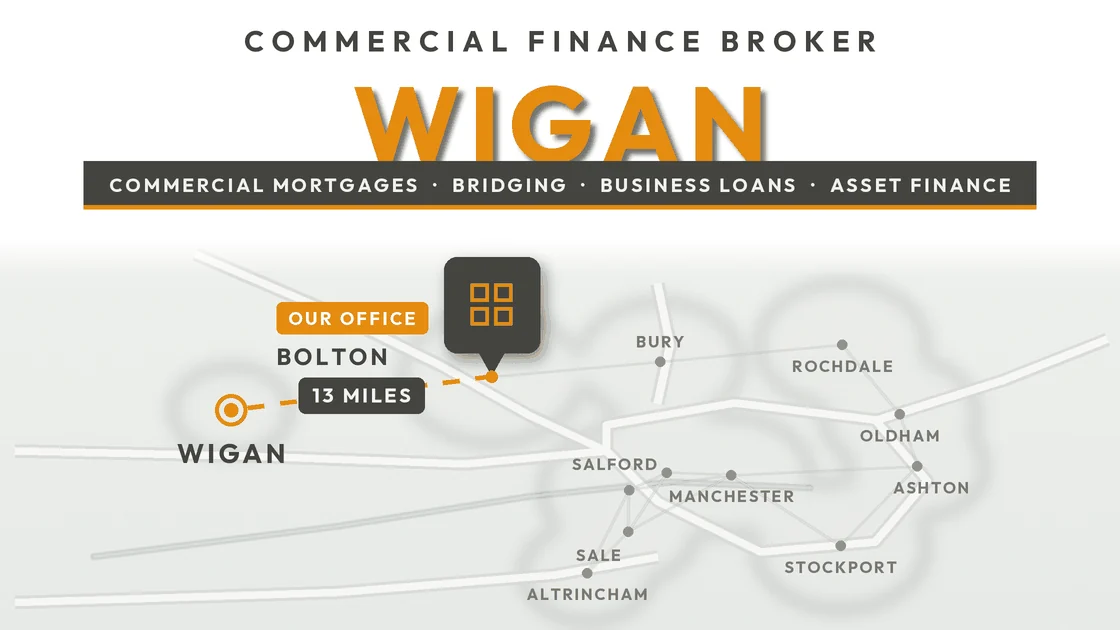
Bolton Business Finance is an independent commercial finance broker working with businesses and property investors across Wigan and Leigh. We arrange business loans, invoice finance, asset finance, commercial mortgages, buy to let and property investment finance, bridging and development finance. Our office is thirteen miles away, about half an hour along the A58.
We are the business loan and commercial mortgage broker Wigan firms can actually sit down with. We do not lend ourselves. We approach the lenders most likely to say yes to your particular case, and we will come to your premises rather than handle the whole thing by email.
Written by Marcus Wright, owner and founder of Bolton Business Finance Ltd, in financial services since 2008 and a commercial finance broker since 2019. Last reviewed September 2026.
On this page
- We will come to you in Wigan and Leigh
- Business loans in Wigan
- Food manufacturing and the supermarket supply chain
- Invoice finance and asset finance
- Buy to let and property investment in Wigan
- Commercial mortgage broker Wigan
- Bridging and development finance
- What we do not do
- Wigan businesses we work with
- Meeting us in Wigan
- Wigan commercial finance FAQs
- Apply for commercial finance in Wigan
The short version
- A commercial finance broker arranges funding for businesses from lenders across the market, rather than lending money itself.
- Unsecured business loans commonly run from £10,000 to £500,000 and can be decided in days rather than weeks.
- Invoice finance releases cash tied up in unpaid invoices, typically up to 90% of the invoice value within a day or two of raising it.
- Buy to let finance arranged through a limited company is business lending. Buy to let on a property you or a family member will live in is regulated and we cannot arrange it.
- A commercial mortgage in Wigan usually takes 3 to 6 months from enquiry to completion. Business loans, asset finance and invoice finance move far faster.
We Will Come To You In Wigan and Leigh
Wigan is about thirteen miles from Westgate House, roughly half an hour on the A58 through Westhoughton. Leigh is closer at around ten miles and usually quicker. Atherton and Tyldesley sit between the two, and for Standish or Ashton-in-Makerfield we tend to pick up the M6 rather than cutting through the town centre.
Wigan is a big borough with two substantial towns in it and a lot of ground between them, which is exactly why turning up matters. A production line, a chilled store, a vehicle fleet parked in a yard: these are things a lender forms a much better view on once someone has actually seen them and can answer questions without going away to check.
| Item | Detail |
|---|---|
| Areas covered | Wigan town centre, Leigh, Atherton, Tyldesley, Hindley, Standish, Ashton-in-Makerfield, Golborne, Orrell, Ince and Platt Bridge |
| Distance from our office | Wigan about thirteen miles and Leigh about ten, via the A58 and A577. Half an hour off peak |
| Products arranged | Business loans, invoice finance, asset finance, commercial mortgages, buy to let and property investment finance, bridging, development finance, merchant cash advances |
| Lender panel | Over 135 lenders, from high street banks to specialist and non-bank funders |
| Broker fee | None on most facilities, we are paid a disclosed commission by the lender. Property secured deals carry £495 upfront and 1% on completion |
| First meeting | Free, at your premises, your accountant’s office or ours |
| Regulatory status | Not FCA authorised. Non-regulated business finance only. No residential mortgages and no consumer buy to let |
Business Loans in Wigan

Across the UK, 99.18% of businesses employ fewer than 50 people and around three quarters employ nobody beyond the owners, according to the government’s Business Population Estimates for 2025. Wigan’s business base sits firmly at that end. That matters because most high street lending policy is built around businesses considerably larger, which is why small firms with perfectly sound trading get turned away.
The two questions worth settling early are how much security you want to give and how fast you need the money, because those two together determine the product more than anything else does.
- Unsecured business loans, typically £10,000 to £500,000. No property charge, decisions often in days. Priced higher than secured borrowing because the lender is taking more risk, and a personal guarantee from the directors is normal rather than exceptional.
- Secured business loans, larger sums against commercial or investment property. Cheaper and longer, but slower, because there is a valuation and a legal process in the middle.
- Revolving credit facilities, which work more like a business overdraft that sits outside your bank. Useful where the need is recurring rather than one off.
- Merchant cash advances, repaid as a percentage of card takings rather than a fixed monthly amount, which suits retail and hospitality with uneven weeks.
If you have already been declined
A decline tells you about that lender’s criteria rather than about whether your business can be funded. Lenders refuse cases for reasons that have nothing to do with the strength of the business: sales below their minimum, a director who does not own a home, a payment provider their systems cannot read, an application already sitting with another introducer. We have placed cases that had been turned down repeatedly, with nothing about the business having changed. What changed was which lender was looking at it.
Food Manufacturing and the Supermarket Supply Chain
Wigan has a food processing and manufacturing base that is unusual for a borough of its size, alongside the distribution operations that sit along the M6 through junctions 25 to 27. If your business makes, packs, chills or moves food, you are in a sector with a very particular financial shape, and it is one that standard lending policy handles poorly.
- Supermarket payment terms are the defining problem. Supplying a major retailer usually means invoicing on long terms while paying for raw materials, packaging, energy and wages on far shorter ones. Win a bigger contract and the gap widens rather than closes. Growth in this sector consumes cash rather than generating it, which is counterintuitive until it happens to you.
- Margins are thin, so the cost of funding matters more than usual. In a sector working on low single figure net margins, the difference between a well structured facility and a badly structured one is not a rounding error, it is the difference between the contract being worth having and not.
- Capital equipment is specialised and expensive. Processing lines, chillers, packing and labelling equipment. Funding that out of trading profit holds a business back for years, and it is precisely the sort of asset that asset finance exists for.
- Customer concentration reads as risk. Depending on two or three large retail customers is normal here and alarming to a credit team. It needs explaining properly, with the contract terms in front of them, rather than being left to be discovered.
- Accreditation and audit costs come before the revenue. Meeting a retailer’s standards usually means spending on facilities and certification well before the first order is invoiced, and last year’s accounts do not show the contract that justifies it.
Where these cases usually land
Almost never on a single term loan. The structure that works is generally invoice finance against the debtor book, so long payment terms stop being your problem, plus asset finance against the equipment, so the line pays for itself across its working life. Splitting the requirement that way is nearly always cheaper than forcing it through one facility, because each part is secured on something the lender understands and can value. Businesses that come to us with the whole operation piled onto an overdraft are usually paying well over the odds for it.
Invoice Finance and Asset Finance in Wigan
Invoice finance is the most under-used product in our range, and in a borough with this much manufacturing and haulage in it that is a shame, because it fits a large number of local businesses better than the loan they end up taking instead.
The principle is straightforward. You raise an invoice, the funder advances most of its value straight away, typically up to 90%, and you get the balance less their charge when the customer pays. It scales with your sales rather than being a fixed sum you have to service whether trading is good or bad, which is why it suits growing businesses far better than a term loan does.
The distinction worth knowing before you enquire
- Factoring means the funder also runs your sales ledger and collects the money. Cheaper in staff terms, but your customers know you are using it.
- Invoice discounting means you keep collecting and your customers see nothing. Confidential, usually requires stronger accounts and better credit control.
- Selective or spot factoring means funding individual invoices rather than the whole book, which suits a business with one very large customer and several small ones.
Most people enquiring want invoice discounting and describe it as factoring. The two are priced and underwritten differently, so it is worth being clear which you actually want.
Asset finance sits alongside it for anything physical: vehicles, trailers, plant, processing and packing equipment, handling equipment and racking. Nil deposit options are available, balloon payments can be used where they help cash flow, and there is no broker fee on asset finance.
Buy To Let and Property Investment in Wigan
Wigan property has had a strong year and the rental market has kept pace with it, which is less common than it sounds. According to ONS and HM Land Registry data, the average house price in Wigan was £196,000 in June 2026, up 6.6% on the year and ahead of the North West rise of 4.7%. Average private rent was £745 a month in July 2026, up 6.9% from £697.
Rents rising very slightly faster than prices means the gross yield has held rather than moved, at about 4.56% against 4.55% a year earlier. That is stability rather than expansion, and it is worth being straight about the headline: at roughly 4.6% Wigan shows the lowest borough-wide gross yield of any of the areas we cover across Lancashire and Greater Manchester. Prices here are simply higher relative to rents than in the old mill towns further east.
That does not make it a poor investment market, but it does mean the borough average is the wrong number to buy on, because the spread by property type here is wide.
| Property type | Average price, June 2026 | Average rent, July 2026 | Gross yield |
|---|---|---|---|
| Flats and maisonettes | £107,000 | £635 | 7.1% |
| Terraced | £158,000 | £747 | 5.7% |
| Semi-detached | £204,000 | £829 | 4.9% |
| Detached | £319,000 | £999 | 3.8% |
The terraced stock yields around 5.7% gross against a borough average of 4.6%, and it has had the strongest capital growth too at 7.3% over the year against 3.4% for flats. Detached property at 3.8% is a capital play rather than an income one, and it is where a lot of the borough average comes from. Anyone modelling a Wigan purchase on the headline figure is understating what the terraced stock does by more than a full percentage point.
Business purpose only
We arrange buy to let and property investment finance on a business basis only, through limited companies, partnerships and portfolio landlords. We are not FCA authorised and we do not arrange consumer buy to let, regulated buy to let or any residential mortgage. If the property is or will be lived in by you or a close family member, that is regulated business and you need an FCA authorised mortgage adviser instead.
Commercial Mortgage Broker Wigan

A commercial mortgage is a loan secured against property used for business purposes. That covers premises your own business trades from, and property you buy to let to a commercial tenant. Terms usually run 3 to 25 years, occasionally up to 30. Lenders typically advance up to 70% of value on commercial property and up to 75% on semi-commercial, meaning a shop or office with a flat above it.
The Wigan commercial market is shaped by the M6 more than by the town centre. Industrial and distribution space along the motorway corridor is modern, well specified and attracts mainstream lenders without much argument. Town centre retail and office stock is a harder sell, as it is in most similar towns, and the older industrial premises scattered through Ince, Platt Bridge and around Leigh are a different proposition again.
What decides your terms
- Property type. Standard industrial, warehousing and offices attract the widest choice. Pubs, hotels, care homes and petrol stations attract specialists only.
- Whether you occupy it or let it. Owner occupied is assessed on your trading accounts. Investment is assessed on the rent and the strength of the tenant.
- Specification. On industrial property, eaves height, power supply and yard space decide who else could take the unit if you left, which is what the lender is really asking.
- Trading history. Two years of filed accounts opens most doors. Less than that pushes you toward specialists.
- Lease length. A short unexpired lease on an investment property narrows the field quickly.
- Condition and EPC. Commercial property let in England generally needs an EPC of E or better, and older stock frequently fails it.
Be realistic on timing. In our experience a commercial mortgage takes 3 to 6 months from first enquiry to completion, and longer on a complicated case. Valuation and legal work are the two stages that overrun most often. If your deadline is weeks rather than months, bridging is usually the honest answer and we will say so.
Our main commercial mortgage broker page sets out lender appetite and typical loan to value by property type, from industrial and offices through to pubs, care homes, petrol stations and places of worship.
Bridging and Development Finance in Wigan
Bridging is short term property lending, usually three to eighteen months, priced monthly and repaid from a sale or a refinance. It comes up on auction purchases, on property bought below mortgageable condition, and on industrial units that need work before a term lender will consider them.
The number that catches people out
Bridging lenders size the loan against the 180 day value, not the open market value. That is what the property would fetch in a forced six month sale, and it is routinely 10% to 20% below the figure in the valuation you paid for. If you have budgeted on the headline valuation, the advance can land well short of what you planned for, and on a twenty eight day auction completion there is no time left to find the difference.
Development finance funds building work rather than a purchase, released in stages against a schedule of works with a valuer signing off each drawdown, and repaid on sale or refinance once the scheme is finished. Wigan sees a reasonable amount of small residential development and industrial refurbishment, and the recurring lender question on both is the same: what is this worth if the scheme stalls halfway through.
- Land or acquisition drawdown. Usually up to 60% to 70% of the purchase price, released on completion.
- Staged build drawdowns. Released in arrears against work completed and signed off by the lender’s monitoring surveyor.
- Practical completion. Final drawdown, and the point at which the exit route has to be real rather than intended.
- Exit. Sale of the units, or refinance onto a commercial mortgage or buy to let facility.
What We Do Not Do
We do not arrange residential mortgages, and we do not arrange consumer buy to let. A good number of people reach this page searching for a buy to let mortgage without knowing that buy to let splits into two categories with different rules.
Business buy to let, held through a limited company or as part of a genuine property investment business, is not regulated and we can arrange it. Consumer buy to let, broadly where you did not set out to be a landlord, or where the property has been or will be lived in by you or a close family member, is regulated and we cannot.
Bolton Business Finance Ltd is not authorised or regulated by the Financial Conduct Authority. We arrange non-regulated commercial and business finance only. That means we cannot advise on or arrange: residential mortgages, first time buyer mortgages, remortgages of your own home, consumer buy to let, equity release, or any consumer credit.
If you need any of those, use the FCA’s Financial Services Register to find an authorised adviser. If you are a business owner, a landlord holding property through a company, or a property investor funding on a commercial basis, then you are in the right place.
Wigan Businesses We Work With
The enquiry mix across the borough reflects a manufacturing and distribution economy with two town centres serving it.
- Food manufacturing, processing and packing, across the borough. Invoice finance against retail contracts and asset finance for processing and packing equipment.
- Haulage, distribution and warehousing, along the M6 corridor through junctions 25 to 27. Vehicle and trailer finance, and invoice finance against contract work.
- Engineering and general manufacturing, on the older estates through Ince, Hindley and around Leigh. Machinery finance and owner occupier commercial mortgages.
- Construction and trades, where the problem is nearly always the gap between doing the work and being paid for it.
- Property investors and landlords, buying terraced stock across Wigan, Leigh, Atherton and Hindley on a limited company basis.
Meeting Us in Wigan
We do not have an office in Wigan and we are not going to pretend otherwise. We are based at Westgate House in Bolton and we travel. Wigan is thirteen miles across and Leigh closer still, so fitting in a meeting is rarely a problem.
Where we will meet you
- At your premises, anywhere in Wigan, Leigh, Atherton, Tyldesley, Hindley or Standish. Usually the most useful option, because we can see the plant, the fleet or the unit.
- At your accountant’s office, which often saves a meeting later when the figures come up.
- At ours in Bolton, if you would rather come to us. Free parking.
- On a call or video, if the case is straightforward and nobody needs to see anything.
Wigan Commercial Finance FAQs
Do you actually visit businesses in Wigan and Leigh?
Yes. Wigan is about thirteen miles from our Bolton office and Leigh about ten, roughly half an hour on the A58 and A577, and we cover the whole borough including Atherton, Tyldesley, Hindley, Standish and Ashton-in-Makerfield. We meet clients at their premises, at their accountant’s office or on site. There is no charge for a first meeting and no obligation to proceed. If you would rather come to us, we are at Westgate House, Westgate Avenue, Bolton, BL1 4RF.
What is the difference between factoring and invoice discounting?
Both release cash tied up in unpaid invoices, usually up to 90% of the value within a day or two. With factoring, the funder also runs your sales ledger and collects payment, so your customers know the facility is in place. With invoice discounting you keep collecting yourself and the arrangement stays confidential, but lenders generally want stronger accounts and better credit control before offering it. There is also selective or spot factoring, where you fund individual invoices rather than the whole book. Most people who enquire about factoring actually want discounting, so it is worth being clear which you mean.
How long does a commercial mortgage take?
Typically 3 to 6 months from first enquiry to completion, and longer on a complicated case. Valuation and legal work are the two stages that overrun most often. If your deadline is weeks rather than months, bridging is usually the honest answer and we will tell you that rather than start an application that cannot land in time.
How much can I borrow?
On commercial property, typically up to 70% of value, or up to 75% on semi-commercial. On unsecured business loans, commonly £10,000 to £500,000 depending on turnover and trading history. On asset finance it is driven by the asset itself, with nil deposit options available. On invoice finance, usually up to 90% of the invoice value released within a day or two of raising it.
Can you help if I have already been declined?
Often, yes. A decline reflects one lender’s criteria, not a verdict on your business. Lenders turn cases down for reasons that have nothing to do with whether the business is sound, and with more than 135 lenders on our panel the question is usually which one to approach rather than whether anyone will look at it. Tell us who has already seen the case, because approaching the same lender twice through a different route does not help you.
Do you charge a broker fee?
Not on most facilities. On business loans, asset finance, invoice finance and merchant cash advances we are paid a commission by the lender, which is disclosed to you. Property secured deals carry a £495 upfront fee and 1% on completion. You will know the full cost before anything is submitted.
Apply For Commercial Finance in Wigan
Tell us what you need funding for
Send us the outline and we will tell you honestly whether it is fundable, roughly what it should cost, and how long it will take. No charge for the conversation and no obligation to proceed. Call 0161 546 9128 or use the form below.
About the author
Marcus Wright is the owner and founder of Bolton Business Finance Ltd. He has worked in financial services since 2008, beginning at Santander, and has been a commercial finance broker since March 2019. He founded the firm in 2020 and is a member of the National Association of Commercial Finance Brokers.
He arranges commercial mortgages, bridging finance, development finance, business loans, asset finance, invoice finance and merchant cash advances for UK businesses, working with a panel of more than 135 lenders. He can be reached on 0161 546 9128.
Marcus is also the author of UK Commercial Finance (2026), a commercial finance book for UK business owners and property investors.
Bolton Business Finance Ltd is registered in England and Wales, company number 12495909. Registered office: Westgate House, Westgate Avenue, Bolton, BL1 4RF.
Bolton Business Finance Ltd is not authorised or regulated by the Financial Conduct Authority. We arrange non-regulated commercial and business finance only, and do not advise on or arrange residential mortgages, consumer buy to let, equity release or consumer credit. All finance is subject to status, lender criteria and credit assessment. Your property may be repossessed if you do not keep up repayments on a mortgage or any other debt secured on it.